BAE Systems: why rising interest rates barely dented a defence company
This was one of the first pieces of company analysis I wrote at university, in spring 2024. The question was simple: pick a company, explain what drives its performance, and assess how the rise in interest rates affected it.
I chose BAE Systems. It turned out to be a good example of a company whose results are explained far more by politics and technology than by the cost of borrowing.
Technology: staying relevant
Defence contractors compete on capability, so sustained investment in research and development is a condition of staying in the market. Over the period I looked at, BAE invested heavily in R&D, worked on linking cyber and military systems so that information can be shared faster, and reached full-rate production on its share of the F-35 Lightning II programme.
The results showed in the top line. Revenue grew from about £20.9bn in 2020 to £25.3bn in 2023, and the share price roughly doubled over the same period.
Politics: the bigger driver
A defence company sells to governments, so its order book follows government priorities.
After Russia's invasion of Ukraine, European countries raised defence spending and orders followed. In the first half of 2023 BAE reported a record £21.1bn of new orders, taking its backlog to £66.2bn. The Financial Times reported that its shares had risen about 70% since the start of 2022, making it one of the best performers in the FTSE 100.
Longer-term agreements mattered as well. The AUKUS partnership between Australia, the UK and the US gave BAE a central role in building the next generation of submarines, which is work measured in decades.
The other side of this is compliance. Operating across the UK, US, Australia and elsewhere means different regulations, different tax rules and strict controls on sensitive information. Political exposure brings contracts, but it also brings scrutiny.
Interest rates: the dog that did not bark
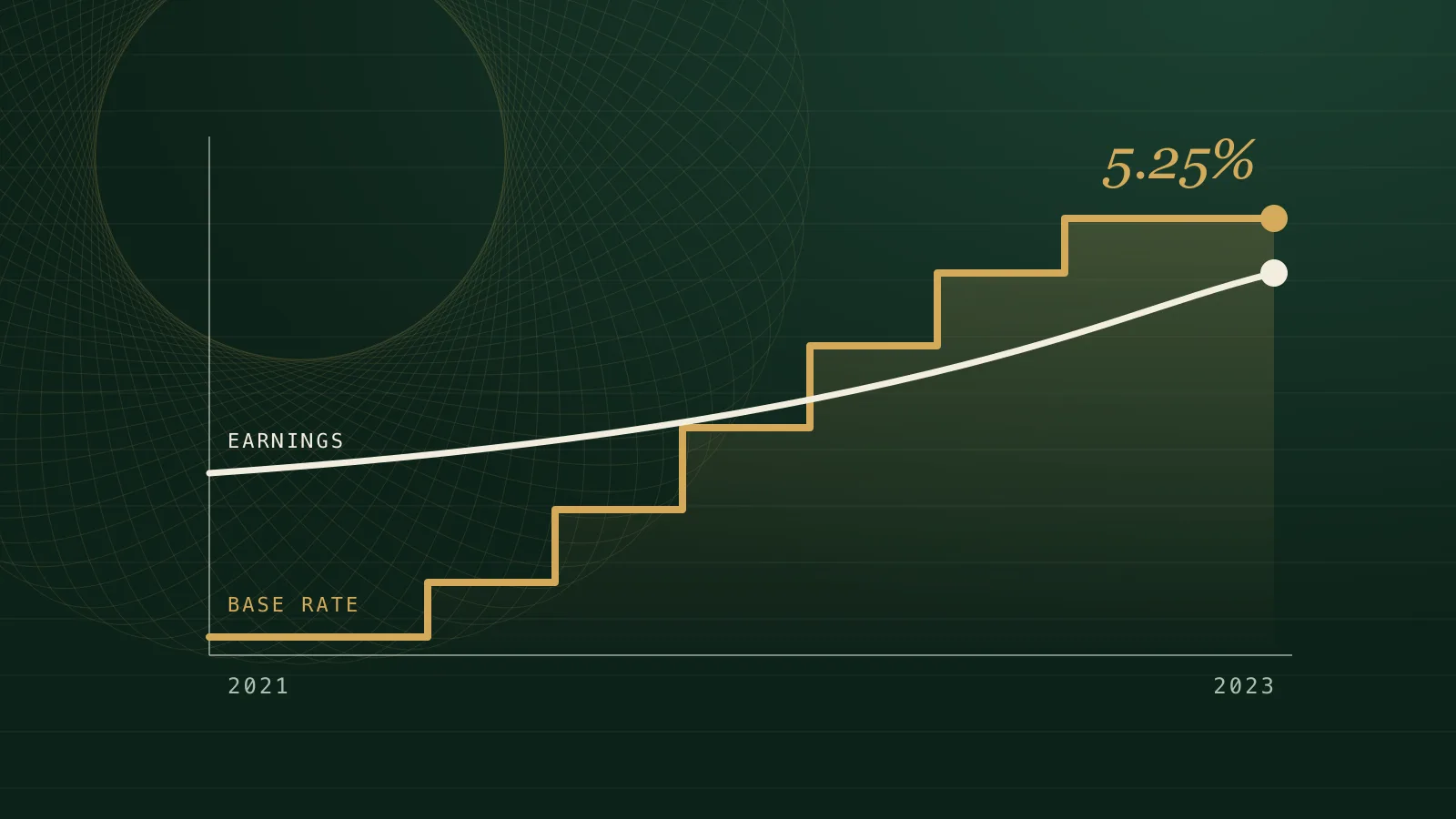
Between late 2021 and 2023 the Bank of England raised its base rate from close to zero to 5.25% to bring inflation down. Higher rates increase the cost of servicing debt, which usually hurts companies with heavy borrowing and thin margins.
For BAE, the effect was small. I looked at three things:
- Gearing. Debt as a proportion of total assets was 71% in 2021, 63% in 2022 and 66% in 2023. High at the start, but lower across the period.
- Interest cover. Averaging around 7 times, meaning operating profit covered interest payments several times over.
- Profitability. Earnings per share rose from 55.2p in 2021 to 61.3p in 2023, and the profit margin improved.
So interest costs did rise, but earnings rose faster. A company with a multi-year order backlog, government customers and strong cash flow is simply not very sensitive to the base rate. The demand for what it sells was being set somewhere else entirely.
What I took from it
The lesson was that a macroeconomic change does not hit every company the same way. Before assuming that higher rates are bad news, look at who the customers are, how long the contracts run, and how the debt is structured. For BAE, the base rate was background noise. The order book was the story.
Based on an essay I wrote in the first year of my BA (Hons) Accounting and Finance at the University of Greenwich, in March 2024. Figures are from BAE Systems' published results and the sources cited in the original essay.